







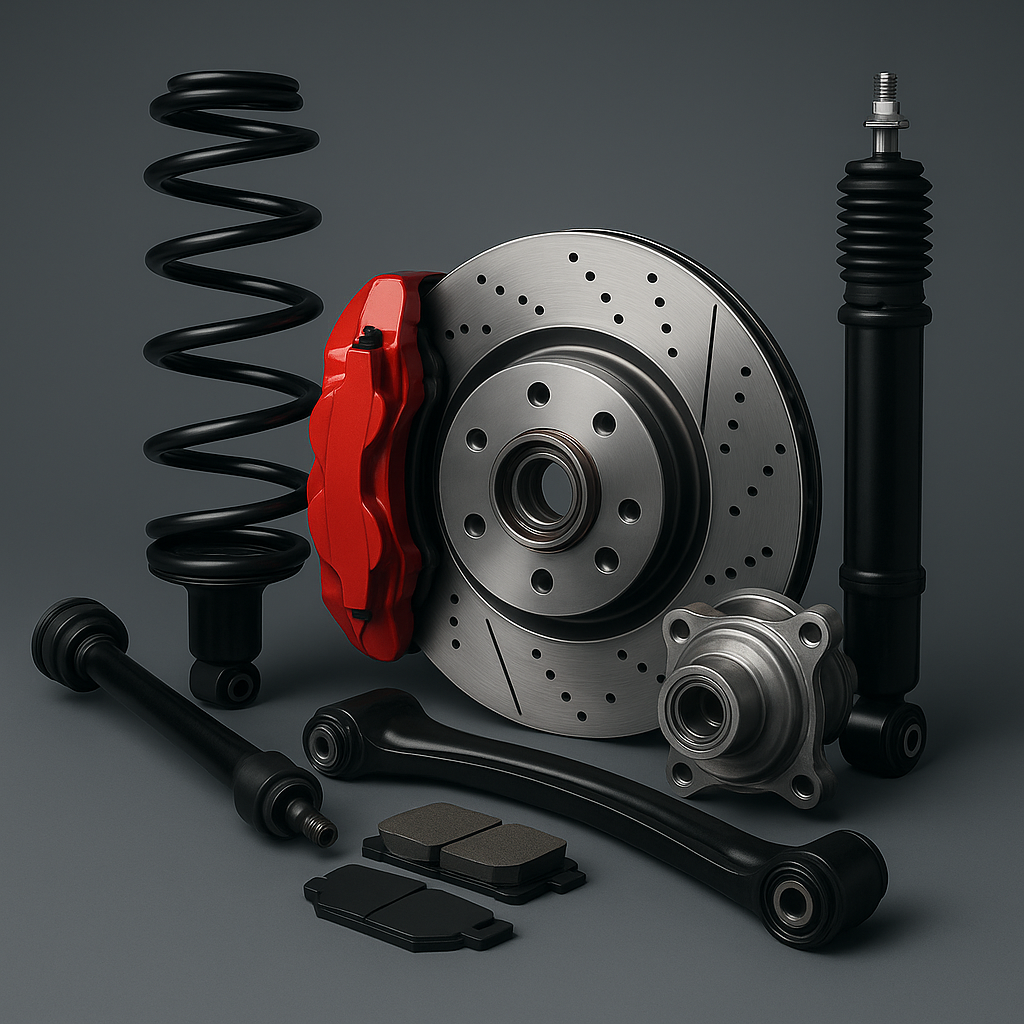
Braking System and Suspension – How to Maintain Safety and Driving Comfort
Braking System and Suspension – How to Maintain Safety and Driving Comfort
The car's braking system and suspension are among the components that have the greatest influence on safety and driving comfort. Even minor neglect can result in longer braking distances, reduced grip and unpredictable behaviour in corners. In this article, we explain how to look after the brakes and suspension, which parts wear most often and how to recognise the first symptoms of a fault.
Brake discs and pads – the foundation of effective braking
Symptoms of worn brake pads:
- squealing or metallic scraping,
- longer braking distance,
- vibration through the brake pedal.
? Advice: if the pedal pulses under braking and the car pulls to one side, it is time to inspect the brake pads and discs.
Brake discs – when should they be replaced?
Cracks, deep grooves or disc run-out, often felt as steering-wheel vibration, are clear signs that replacement may be required.
? Buying advice: replace discs and pads as a matched set on the axle. Brands such as Brembo, ATE, Zimmermann and TRW are well known for durable braking components.
? Also remember the brake calipers. Seized slider pins or pistons can cause the car to pull to one side, overheat the discs and wear the pads prematurely. Cleaning and lubricating the guide pins should be part of a proper pad replacement.
Shock absorbers – comfort, grip and braking distance
Symptoms of worn shock absorbers:
- the car continues bouncing after a bump,
- poorer handling in corners,
- oil leaks on the shock-absorber body.
? Simple test: press down firmly on the body above the wheel and release it. If the car continues to bounce repeatedly, the dampers should be inspected.
Buying advice:
- replace shock absorbers in pairs on the same axle,
- standard oil-filled dampers may be sufficient for normal driving, while gas-pressure dampers can be a good choice for more demanding roads,
- well-known brands include KYB, Sachs, Monroe and Bilstein.
? It is also worth inspecting the suspension springs. A broken spring is not only noisy but can also reduce vehicle stability. Top mounts and bump stops are equally important – worn components can cause knocking noises and reduce ride comfort.
Control arms and bushes – keeping the vehicle stable
Symptoms of wear:
- loud knocking over potholes,
- the car pulling to one side,
- accelerated and uneven tyre wear.
Buying advice:
- complete sets with bushes and ball joints can make installation easier and reduce future problems,
- choose reputable brands such as Lemförder, Febi and TRW.
Anti-roll bars and drop links – control in corners
Symptoms of failure:
- characteristic knocking over uneven surfaces,
- increased body roll in corners.
? Advice: worn anti-roll-bar links will not normally immobilise the vehicle, but they can reduce stability. Replacement is usually quick and inexpensive and can noticeably improve handling.
? In vans and heavier passenger vehicles, leaf springs and suspension beams can also be important. Wear or cracking may cause uneven ride height and unsafe behaviour under heavy loads.
Wheel alignment – why is it so important?
Symptoms of incorrect alignment:
- the car pulls to one side,
- uneven tyre wear,
- increased fuel consumption.
? Remember to inspect wheel bearings and hubs as well. Excessive play or wear affects noise, steering precision and safety. A typical symptom is a humming noise that increases with road speed.
Additional braking-system advice
- replace brake fluid approximately every 2 years because old fluid absorbs moisture and loses performance,
- inspect rigid brake lines and flexible hoses,
- do not ignore the ABS warning light – a functioning system can help maintain control and shorten braking distance on slippery surfaces,
- before a long journey, always check the brakes – it is one of the foundations of road safety.
Seasonal checks of suspension and brakes
- In winter, the suspension is exposed to road salt and frost – inspect bushes and shock absorbers after the season.
- In summer, long journeys can place heavy loads on the brakes – check the discs and brake fluid before holiday travel.
Most common signs that something is wrong
- knocking from the suspension,
- vibration while braking,
- the car pulling to one side,
- longer braking distances,
- a floating or unstable feeling in corners.
Summary
Looking after the braking system and suspension is essential for safe and comfortable driving. Regular replacement of brake pads and discs, checking shock absorbers, control arms and anti-roll-bar components, and periodically checking wheel alignment can help prevent costly repairs and keep the car predictable in all conditions.Remember – good-quality automotive parts are an investment in your safety.