







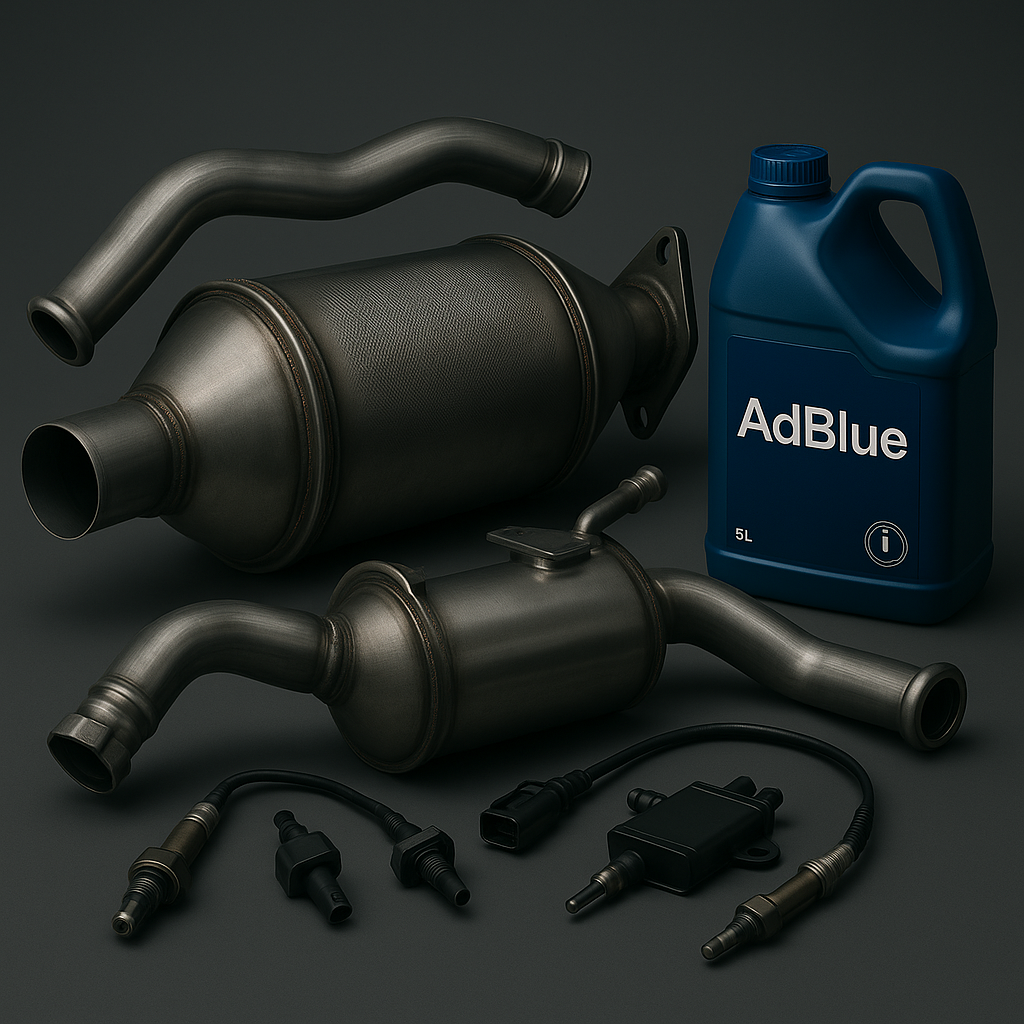
DPF, FAP and AdBlue – Eco-Friendly Solutions in Modern Cars
DPF, FAP and AdBlue – Eco-Friendly Solutions in Modern Cars
Modern cars must meet increasingly strict exhaust-emission standards. To achieve this, manufacturers use advanced exhaust-treatment systems:
DPF, FAP and AdBlue.
Each of these solutions has a different design, operating principle and maintenance cost.
In this article, we explain how these systems work, what their advantages and weaknesses are, and how to look after them in everyday use.
DPF – diesel particulate filter
A DPF (Diesel Particulate Filter) is fitted to diesel vehicles. Its task is to trap soot particles produced during diesel combustion.
Advantages
- effectively reduces particulate emissions,
- makes the vehicle more environmentally friendly,
- works automatically while driving.
Disadvantages
- can clog during frequent city driving,
- requires regular regeneration cycles,
- pressure-sensor faults can mimic a blocked filter.
? Advice: every few thousand kilometres, it is worth taking the car for a longer drive at higher engine speeds so the filter can regenerate. This is the cheapest form of DPF regeneration.
FAP – the French version of the particulate filter
FAP is used mainly in PSA vehicles (Citroën, Peugeot, DS) and differs from a conventional DPF because it uses Eolys catalytic fluid, which allows soot to burn off at a lower temperature.
Advantages
- faster and more effective soot regeneration,
- lower risk of clogging in mixed driving,
- lower system operating temperature.
Disadvantages
- Eolys fluid must be replenished approximately every 100,000–150,000 km,
- higher servicing costs,
- possible pump and dosing-system failures.
? Tip: before buying a car with an FAP system, check whether the Eolys fluid has been replenished — neglecting this service can quickly clog the filter.
AdBlue – reducing nitrogen oxides in diesel engines
AdBlue is a urea solution used in the SCR system to neutralise nitrogen oxides (NOx). This system is found in newer diesel vehicles that meet Euro 6 and later emission standards.
How does AdBlue work?
- the fluid is injected into the exhaust system,
- at high temperature it breaks down into ammonia,
- the ammonia neutralises NOx in the SCR catalytic converter.
Advantages
- very low NOx emissions,
- compliance with current emission standards,
- no negative effect on engine performance.
Disadvantages
- requires regular topping up,
- freezes below –11°C,
- an AdBlue pump failure can prevent the vehicle from starting.
? Advice: only use AdBlue that complies with ISO 22241 — cheaper fluids may crystallise inside the pump and cause expensive damage.
Differences between DPF, FAP and AdBlue
The table below summarises the main differences:
| System | Engine type | What does it remove? | Components requiring service | Maintenance costs |
|---|---|---|---|---|
| DPF | Diesel | Soot | pressure sensors, filter | medium |
| FAP | PSA diesel | Soot (with Eolys fluid) | Eolys fluid, filter, pump | higher |
| AdBlue (SCR) | Euro 6 diesel | NOx | AdBlue pump, injector | medium–high |
Typical symptoms of failure
Symptoms of a clogged DPF/FAP:
- loss of power,
- higher fuel consumption,
- frequent regeneration / limp mode,
- filter warning light.
Symptoms of AdBlue problems:
- “Refill AdBlue” message,
- reduced power,
- engine-start lockout after the remaining-distance limit is reached,
- pump or sensor errors.
? Diagnostic advice: if the filter clogs very quickly, check the pressure and temperature sensors first — they are often responsible for false alarms.
Service and running costs
| Service type | DPF | FAP | AdBlue |
|---|---|---|---|
| Regeneration | PLN 300–600 | PLN 400–700 | — |
| Fluid refill | — | PLN 300–600 | PLN 50–100 |
| Pump reconditioning | — | PLN 400–900 | PLN 800–1,500 |
| New filter/system | PLN 1,500–5,000 | PLN 1,800–6,000 | PLN 2,500–7,000 |
? Buying tip: avoid very cheap DPF/FAP filters — they often have poorer flow characteristics and can clog quickly.
How should you look after these systems?
- use good-quality fuel,
- change the engine oil regularly (ideally every 10,000 km),
- avoid repeated short journeys with a cold engine,
- respond to warning lights and messages — ignoring them almost always results in a more expensive repair.
? Final advice: drivers who mainly make short journeys should consider a petrol engine or a hybrid — diesel engines with DPF/FAP/AdBlue systems work best on longer trips.
Summary
DPF, FAP and AdBlue are key systems for reducing exhaust emissions. Each works differently, but they all share one goal:
to reduce emissions and make diesel engines cleaner.
Good-quality fuel, regular servicing and informed use are the best ways to avoid expensive repairs and keep these systems working properly.