







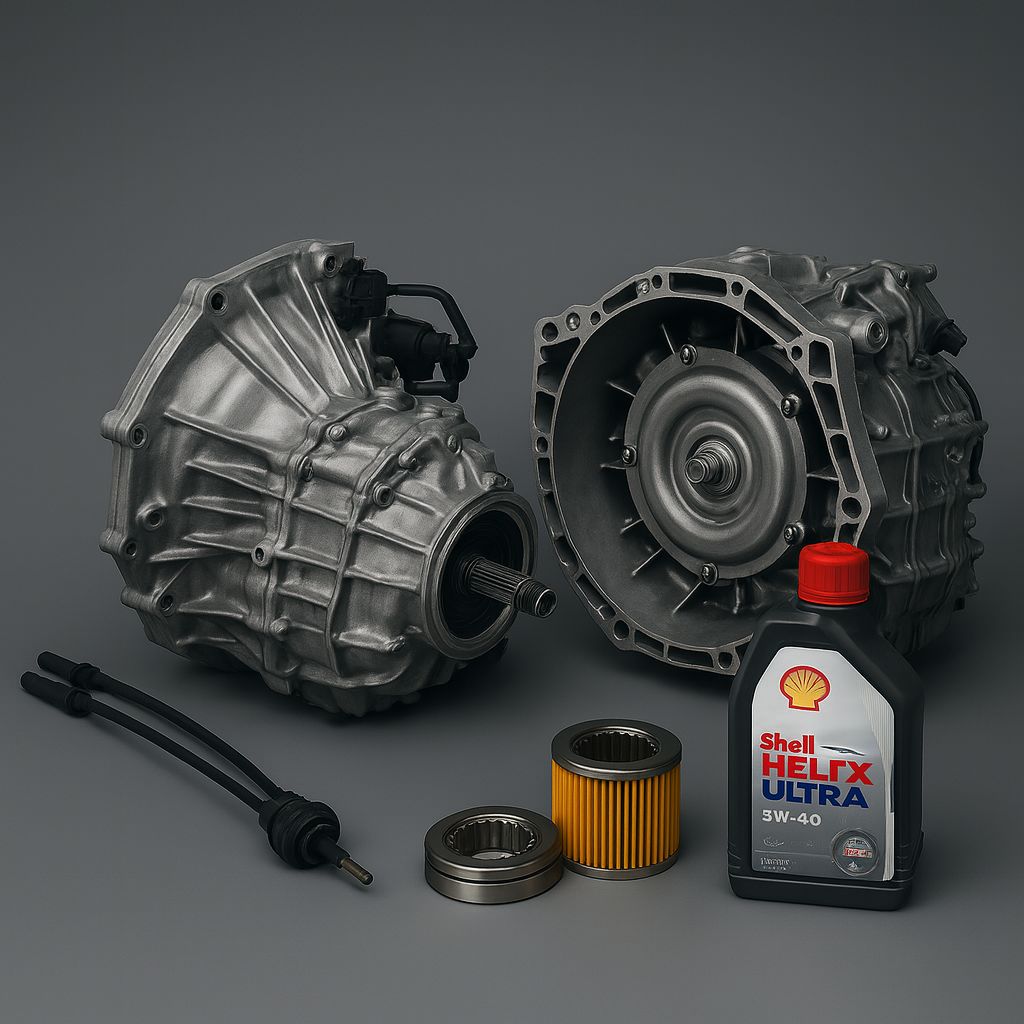
Gearbox – How to Keep It Reliable and When to Replace Parts
Gearbox – How to Keep It Reliable and When to Replace Parts
The gearbox is at the heart of the drivetrain – it is responsible for smooth driving and transferring engine power to the wheels. Neglecting maintenance can lead to expensive repairs, so it is worth knowing how to care for it properly. In this article, we explain when to change transmission oil, how to recognise problems with synchronisers, bearings and seals, and what parts to choose when buying replacements.Transmission oil – the foundation of long service life
Transmission oil lubricates and cools gearbox components. As it ages, it loses its properties, accelerating wear.- In a manual gearbox, change the oil every 60,000–80,000 km.
- In an automatic gearbox, change it every 40,000–60,000 km.
? In automatic transmissions, overheated oil is one of the main causes of failure. For cars that tow trailers or are frequently driven in mountainous areas, an additional transmission-oil cooler can be a worthwhile upgrade.
Manual vs automatic gearbox – differences in operation
- Manual gearbox – simpler in design and generally cheaper to repair. Typical faults include a worn clutch, gearshift cables and leaks.
- Automatic gearbox – offers greater driving comfort but usually costs more to service. Common faults include worn clutch packs, solenoids, overheated oil and, in newer transmissions, failures of the mechatronic unit that controls gear changes.
? Tip: when buying a used automatic car, always check the transmission-oil service history. Missing service records mean a significantly higher risk of failure.
? In manual cars, clutch wear can show up as slipping under acceleration. In automatics, jerking during gear changes is common and may be caused by control electronics.
Seals and oil leaks
Leaking gearbox seals can lower the oil level. Problems most commonly occur around the driveshaft and input-shaft oil seals.
? Buying tip: choose seals from reputable brands such as Elring or Corteco. Cheap replacements can lose their seal quickly and cause recurring leaks.
? When checking for leaks, inspect the driveshafts and CV joints as well. Damaged rubber boots can throw grease around and lead to additional drivetrain faults.
Gearbox bearings
Bearings allow gearbox shafts to rotate smoothly. Wear is often indicated by a loud whining noise at particular road or engine speeds.
? Tip: ignoring the noise can eventually damage the gearbox housing, multiplying the repair cost.
? In automatic transmissions, whining can also be caused by planetary-gear bearings or damaged vibration dampers in the torque converter.
Synchronisers – smooth gear changes
Worn synchronisers can cause grinding during gear changes and make gears difficult to engage.
? Buying tip: if you are rebuilding the gearbox, consider buying a complete synchroniser set. It is often more economical than replacing individual components.
? Synchroniser wear can easily be confused with clutch problems. If gears grind even when the clutch pedal is fully depressed, the synchronisers are more likely to be at fault than the clutch disc.
Gearshift mechanism – cables and gear lever
Play in the gear lever and difficulty selecting gears precisely are often caused by worn cables or the selector mechanism.
? Driver tip: if the gearshift feels vague or “rubbery”, check the guide bushes. They are inexpensive and can make a noticeable difference to shift quality.
? Performance and heavy-duty vehicles may also use precision or short-shift mechanisms. Small amounts of play can still matter, while poorly matched parts may shorten the service life of the cables and selector.
Most common symptoms of gearbox failure
- whining or excessive noise while driving,
- difficulty engaging gears,
- grinding during gear changes,
- oil leaks under the vehicle,
- the gearbox jumping out of gear while driving.
? Also watch for jerking during downshifts in an automatic transmission, which may indicate a solenoid problem, or a metallic knock when pulling away, which can be a sign of a worn clutch release bearing.
Gearbox care in winter
Low temperatures cause transmission oil to thicken, making the gearbox work harder.- After starting the car, give the gearbox a moment to warm up, especially with an automatic.
- Avoid abrupt gear changes while the oil is still cold.
- Check the oil level and condition regularly – leaks may be easier to notice in winter.
How to care for the gearbox every day
- Change the oil according to the recommended schedule.
- Do not rest your hand on the gear lever – this can place unnecessary load on the synchronisers.
- In an automatic transmission, keep the oil properly cooled – overheating shortens transmission life.
- Avoid aggressive launches and harsh gear changes.
? Remember to inspect the driveshafts and propeller shafts as well. Worn joints can cause knocking when turning and transmit vibration to the gearbox.
Summary
A gearbox – whether manual or automatic – requires regular maintenance. By taking care of transmission oil, seals, bearings, synchronisers and the gearshift mechanism, you can avoid costly failures and enjoy smooth driving for many years.Remember – proven car parts, regular servicing and a quick response to the first symptoms of a fault are among the best investments in vehicle reliability.