







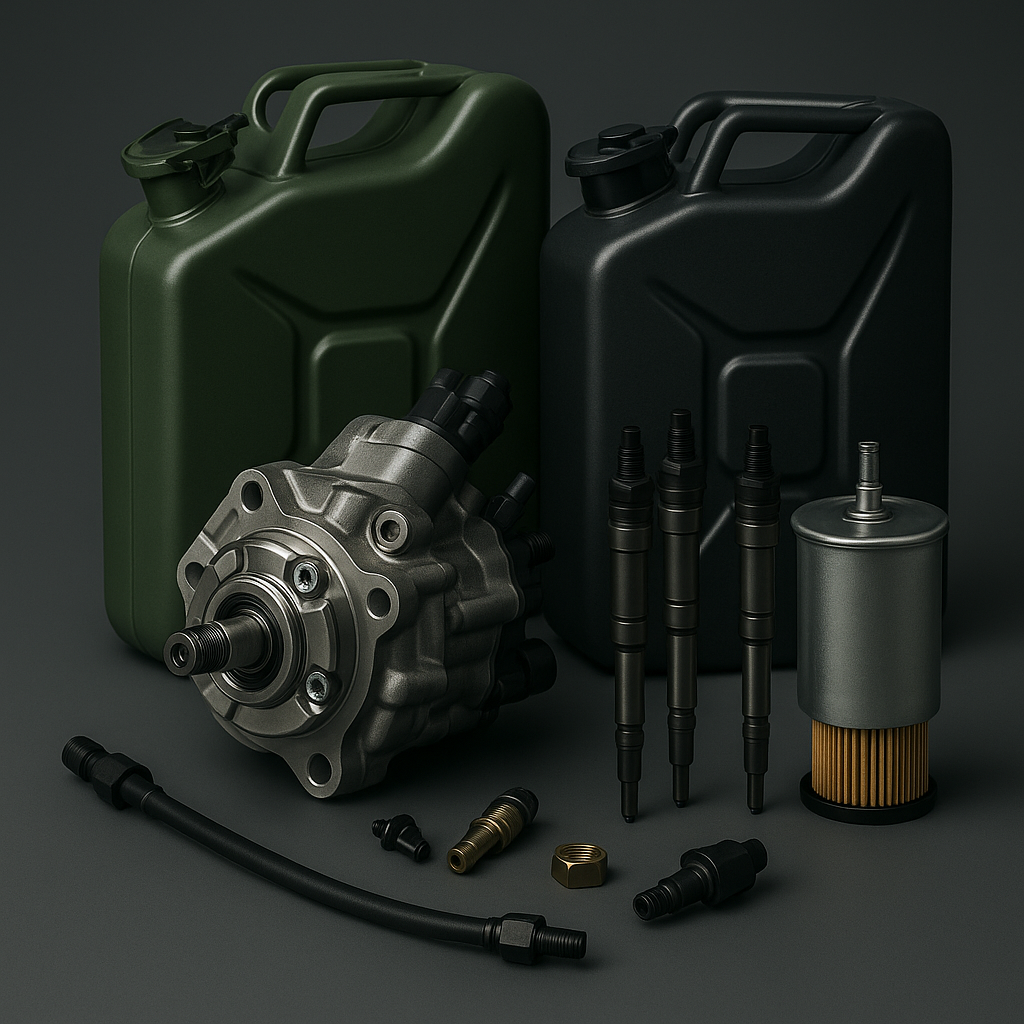
How Does Fuel Quality Affect Engine and Component Wear?
How Does Fuel Quality Affect Engine and Component Wear?
Fuel quality is one of the most important factors affecting the durability of an engine and its ancillary components. Although many drivers choose where to refuel largely by habit, differences in fuel composition, sulphur content, octane rating and cleanliness can lead to serious failures.
In this article, we explain how fuel affects injectors, the turbocharger, high-pressure pump, DPF, catalytic converter and the overall operation of the engine.
Why does fuel quality matter so much?
Modern power units — especially turbocharged engines and engines with direct injection — operate under very high loads.
Any fuel contamination, an octane rating that is too low or excessive sulphur content can:
- reduce power,
- increase fuel consumption,
- cause engine knock,
- accelerate wear of fuel-system components,
- clog the DPF/FAP,
- shorten turbocharger life.
? Tip: in modern TSI, GDI, HDI, DCI, TCe and Multijet engines, fuel quality matters more than it did in older designs.
How fuel quality affects key components
Fuel injectors
These are among the most precise components in a modern engine.
Poor-quality fuel can cause:
- clogged injector nozzles,
- uneven engine operation,
- starting problems,
- higher fuel consumption,
- expensive repairs (reconditioning PLN 500–1,200, new injectors PLN 900–2,500 each).
? Advice: use one trusted fuel-station network — differences in quality between stations can often cause uneven injector operation.
Turbocharger
Although the turbocharger itself is lubricated by engine oil, fuel quality has a direct effect on it.
Effects of poor-quality fuel:
- more carbon deposits,
- higher exhaust-gas temperatures,
- increased load on the turbine wheel,
- faster bearing wear.
? Tip: carbon deposits caused by unburned fuel increase flow resistance, placing more strain on the turbo than dynamic driving itself.
High-pressure pump
In both petrol and diesel engines, the high-pressure pump operates under enormous pressure.
Contaminated fuel = rapid wear.
This can lead to:
- metal particles generated by pump wear (DIESEL),
- seizing of pump plungers,
- damage to the entire Common Rail system.
? Cost of failure:
reconditioning PLN 700–1,500,
new pump PLN 1,500–4,000.
DPF / FAP
Low-quality fuel contains more sulphur and ash, which accelerates filter clogging.
Symptoms:
- frequent regeneration cycles,
- limp mode,
- higher fuel consumption,
- clogged DPF = PLN 600–2,000 for regeneration.
? Advice: use fuel with cleaning additives — it can reduce the amount of soot and ash.
Catalytic converter
The catalytic converter is sensitive to fuel composition and combustion temperature.
Poor fuel can mean:
- unburned residues damaging the ceramic core,
- excessive temperatures,
- clogging and lambda-sensor errors.
Cost of a new unit: PLN 500–2,500 (petrol), PLN 1,500–4,000 (diesel).
Petrol – is 95 octane always enough?
The octane number indicates a fuel's resistance to engine knock.
Using 95 octane in an engine that requires 98 can lead to:
- reduced power,
- overheating,
- ignition-timing corrections,
- higher fuel consumption,
- faster wear of piston rings and pistons.
✔ If the manufacturer permits both 95 and 98 — 98 is worth considering for dynamic driving and long-distance journeys.
Diesel – where do the problems come from?
The main risks are:
- water in the fuel (damages the pump and injectors),
- sulphur (clogs the DPF and catalytic converter),
- poor lubricating additives (unit injectors and Common Rail components can operate with insufficient lubrication),
- bacteria in the fuel (particularly in contaminated tanks).
? Advice: every 2–3 months, it can be worth adding a reputable lubricity additive to diesel fuel.
Differences between premium and standard fuel
| Fuel type | Advantages | Disadvantages | When is it worth using? |
|---|---|---|---|
| Standard 95 / diesel | good for city driving, cheaper | weaker cleaning additives | everyday, relaxed driving |
| Premium fuels | better combustion, smoother operation, injector protection | higher price | dynamic driving, long trips, modern engines |
| Fuel with premium additives | ideal for turbocharged and direct-injection cars | none | preventive maintenance, keeping the fuel system clean |
Symptoms of poor-quality fuel
- fluctuating idle speed,
- loss of power,
- noisy engine operation,
- smoke (diesel),
- jerking,
- starting difficulties,
- rapid DPF clogging.
? Advice: if the problem appears immediately after refuelling → drain the tank and change fuel stations. This happens more often than you might think.
Repair costs caused by poor fuel
| Failure | Approximate cost |
|---|---|
| Injectors | PLN 800–2,500 each |
| High-pressure pump | PLN 1,500–4,000 |
| DPF | PLN 600–2,000 for regeneration |
| Turbocharger | PLN 1,000–3,500 |
| Catalytic converter | PLN 500–4,000 |
How can you avoid problems?
- refuel at trusted stations,
- avoid small, unknown roadside stations,
- do not drive constantly on reserve — contaminants from the bottom of the tank may be drawn into the system,
- use fuel additives every 5,000–10,000 km,
- replace the fuel filter regularly.
? Final advice: drivers who mainly make short journeys may benefit from premium fuel — it can help keep the fuel system cleaner for longer.
Summary
Fuel quality has a major impact on the durability of the engine and its components.
Cheap fuel can often turn out to be the most expensive option because it can rapidly wear injectors, the pump, turbocharger or DPF.
Refuelling at trusted stations, using appropriate additives and carrying out regular servicing are the best ways to avoid serious failures and enjoy trouble-free driving.