







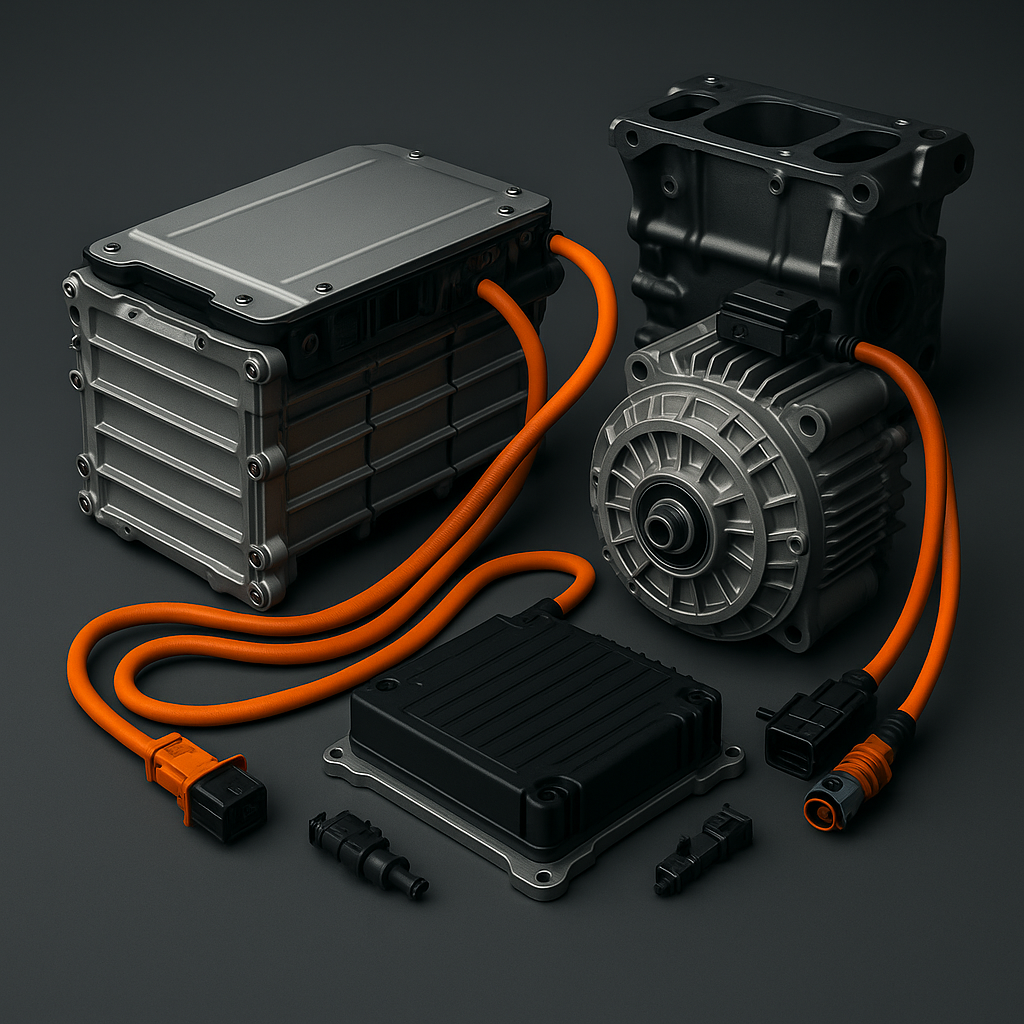
Hybrids – Economy and Ecology in One
Hybrids – Economy and Ecology in One
Hybrid cars are now one of the most popular choices among drivers looking for lower running costs, reliability and more environmentally friendly solutions. They combine an internal combustion engine with an electric motor, helping to reduce fuel consumption, lower exhaust emissions and improve driving comfort in the city.
In this article, we explain how hybrids work, what types are available, what they cost to run and which models are worth considering.
How does a hybrid car work?
A hybrid uses two power sources:
- Internal combustion engine – usually petrol, optimized for low-load operation.
- Electric motor – assists with pulling away, acceleration and driving in traffic.
While driving, energy is recovered during braking and stored in the battery. As a result, hybrids use less fuel and produce fewer emissions.
? Tip: the more city driving you do, the more clearly a hybrid shows its advantages.
Types of hybrids – what is the difference?
Mild Hybrid (MHEV)
- the least electric assistance,
- the electric motor only supports the combustion engine and cannot drive the car on its own,
- lower fuel consumption and no need to plug in.
Full Hybrid (HEV)
- classic hybrids (for example Toyota),
- can drive using electric power alone,
- very low fuel consumption in the city.
Plug-In Hybrid (PHEV)
- charged from an external power source,
- electric range of 30–80 km,
- the lowest fuel consumption on short journeys.
? Advice: if you can charge at home or at work → choose a PHEV. If you mainly drive in the city → choose an HEV.
Advantages of hybrid cars
- very low fuel consumption in the city,
- quiet operation and smooth acceleration,
- lower exhaust emissions,
- no turbocharger and lower failure rates of the petrol engine,
- cheaper servicing than diesels and turbocharged engines,
- high resale value.
Disadvantages of hybrids
- weaker performance under heavy load,
- higher purchase price,
- smaller boot (due to the battery),
- the cost of replacing the traction battery (although this is rarely necessary).
? Tip: modern batteries often last 250,000–350,000 km without replacement.
Most popular hybrid models
| Model | Hybrid type | Average fuel consumption | Advantages |
|---|---|---|---|
| Toyota Corolla Hybrid | HEV | 4.0–5.0 l | durability, low fuel consumption |
| Toyota RAV4 Hybrid | HEV | 5.5–6.5 l | power, 4x4 drive, reliability |
| Hyundai Ioniq Hybrid | HEV | 4.0–5.0 l | economy, modern technology |
| Kia Niro Hybrid | HEV/PHEV | 4.2–5.2 l | versatility, low running costs |
| Mitsubishi Outlander PHEV | PHEV | 2.0–3.0 l (with charging) | economy, short journeys |
| Ford Kuga Plug-In | PHEV | 1.5–3.0 l | long electric range |
? Buying tip: full HEVs are best for city driving. If you drive a few to a dozen or so kilometres every day → a PHEV can cover much of that distance at almost no fuel cost.
Real-world fuel consumption in hybrids
| Driving mode | MHEV | HEV | PHEV |
|---|---|---|---|
| City | 5.5–7.0 l | 3.5–5.0 l | 0–2.5 l (with charging) |
| Open road | 5.5–7.5 l | 4.5–6.0 l | 5.0–7.0 l |
| Motorway | 7.0–9.0 l | 6.5–8.0 l | 6.5–8.5 l |
? Conclusion: hybrids deliver the greatest savings in the city and on short journeys.
Typical faults and costs
Despite the myths, hybrids are very durable, but they do have a few components that require attention.
| Component | Possible problems | Repair cost |
|---|---|---|
| Traction battery | capacity loss | PLN 3,000–7,000 (reconditioning) |
| Inverter | overheating | PLN 2,000–5,000 |
| Battery cooling system | dirt, fan failures | PLN 300–1,500 |
| Internal combustion engine | normal wear | similar to a conventional petrol engine |
? Advice: it is worth cleaning the traction battery air intake once a year — it collects dust and pet hair, which can increase battery temperatures.
Who is a hybrid for?
- drivers who mainly travel in the city,
- people who value quietness, comfort and smooth driving,
- those who want to reduce fuel costs,
- those who do not want a diesel but still need good fuel economy,
- fleet drivers (reliability and low running costs).
Summary
Hybrids are an excellent combination of economy and ecology. They use less fuel, produce fewer emissions and can be considerably more reliable than modern turbocharged engines.
Although they can cost more to buy, the savings on fuel and servicing can more than make up for the difference.
For most drivers — especially those who mainly drive in cities — a hybrid is currently one of the most sensible choices.